Impact
This single product shift moved the company from reactive revenue rescue to proactive, compounding growth.
Scale
Build for trust
20% ↑
ARR
Clear
No need to talk to humans
40% ↓
Drop in tickets
Self-service
Forget having people do it for you
8% ↑
Upsell
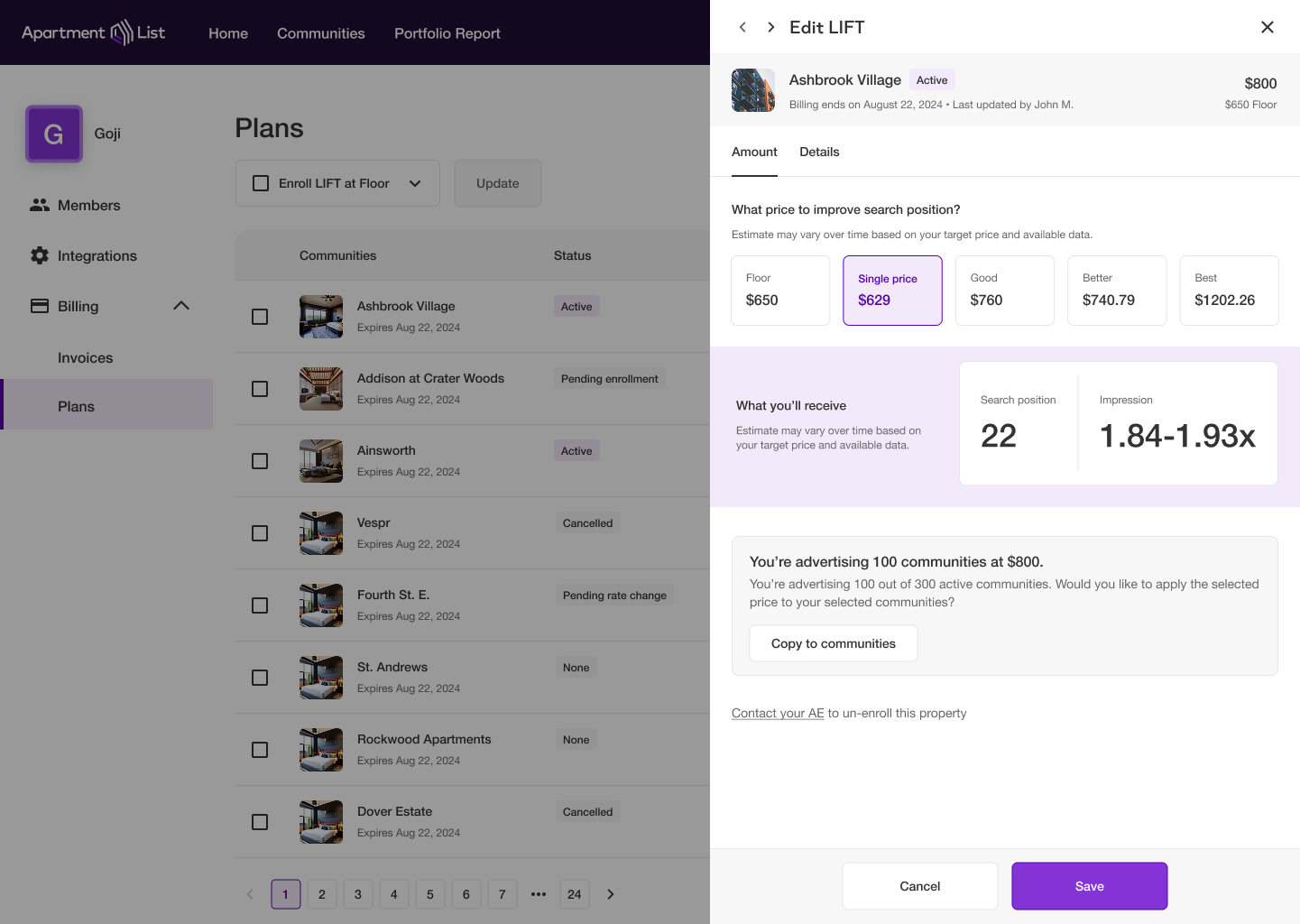
In 30 days, I designed and launched the company’s first unified billing system to help partners see and predict their charges. The goal was to make billing transparent, easy, and self-serve, so partners could trust the system, reduce confusion, and increase revenue without relying on Sales. Support escalations dropped about 40%, adoption of premium features went up, and 20% of at-risk ARR was recovered. We focused on the most important features to deliver value quickly while building a foundation to grow.
The surface issue sounded like “billing confusion.” The real issue was no product and trust collapse in how money moved through the product.
The company had no billing product. Invoices lived in emails, support threads, and one-off finance workflows. That fragmentation put nearly $5M in ARR at risk through unpredictable charges, slow collections, and partner distrust. The organization wanted to scale, but billing was the bottleneck.
$5m
Churn risk
30%
Loss in upsell
400+
Partner tickets/mo
Guiding principle
Make spend predictable, explainable, and controllable without Sales involvement by creating a unified billing system with self-service.
I started from zero; no roadmap, no defined MVP, no system to inherit.
My early work included:
• Authored the foundational design brief (problem space, constraints, risks, milestones)
• Mapped trust failures and revenue leakage across workflows
• Set MVP priorities with Engineering and Product, balancing risk, feasibility, and business impact
• Created MVP assumptions via prototypes and iterative testing
I made three key hypothesis supported by 1:1 interviews with 10 stakeholders to define the MVP.

Full billing visibility was impossible within timeline constraints
Early prototypes revealed that full billing visibility was impossible within timeline constraints. I reframed the problem, isolating three high-leverage levers that could deliver immediate, measurable impact with the PM. This approach allowed us to deliver tangible business value immediately while building a platform for long-term scalability.
Increased transparency, reduced “billing surprise,” and empowered partners to make confident upgrades without Sales intervention.
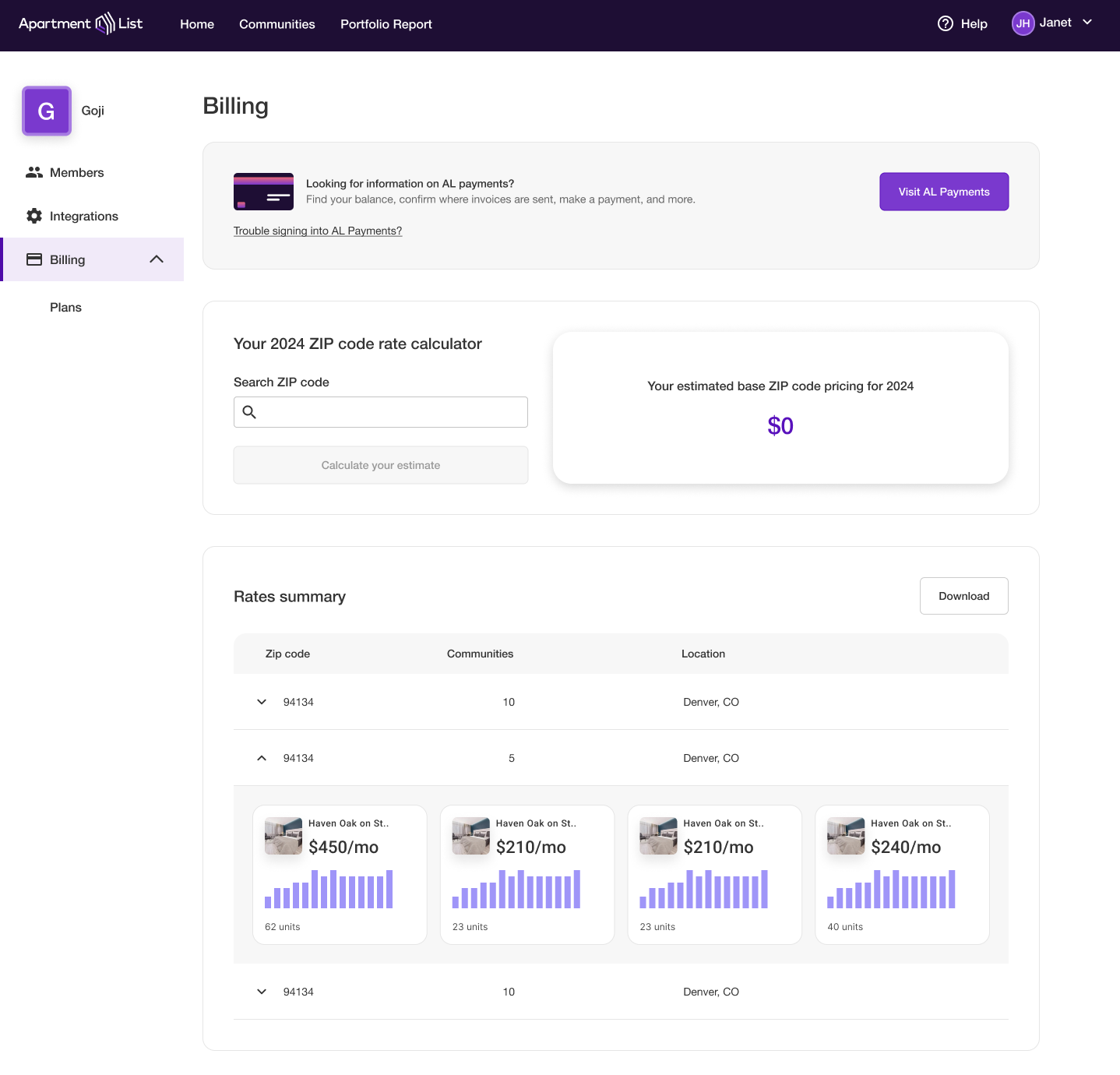
Options: Static invoice view / summary table / real-time interactive calculator
Constraint: Tight timeline + partner confusion
Call: Interactive rates calculator and static view with real-time updates
Risk: Could overwhelm users if too detailed
Mitigation: Progressive disclosure, itemized breakdowns for cost drivers
Proof: Partners immediately understood spend impact; support tickets for rate disputes dropped 40%
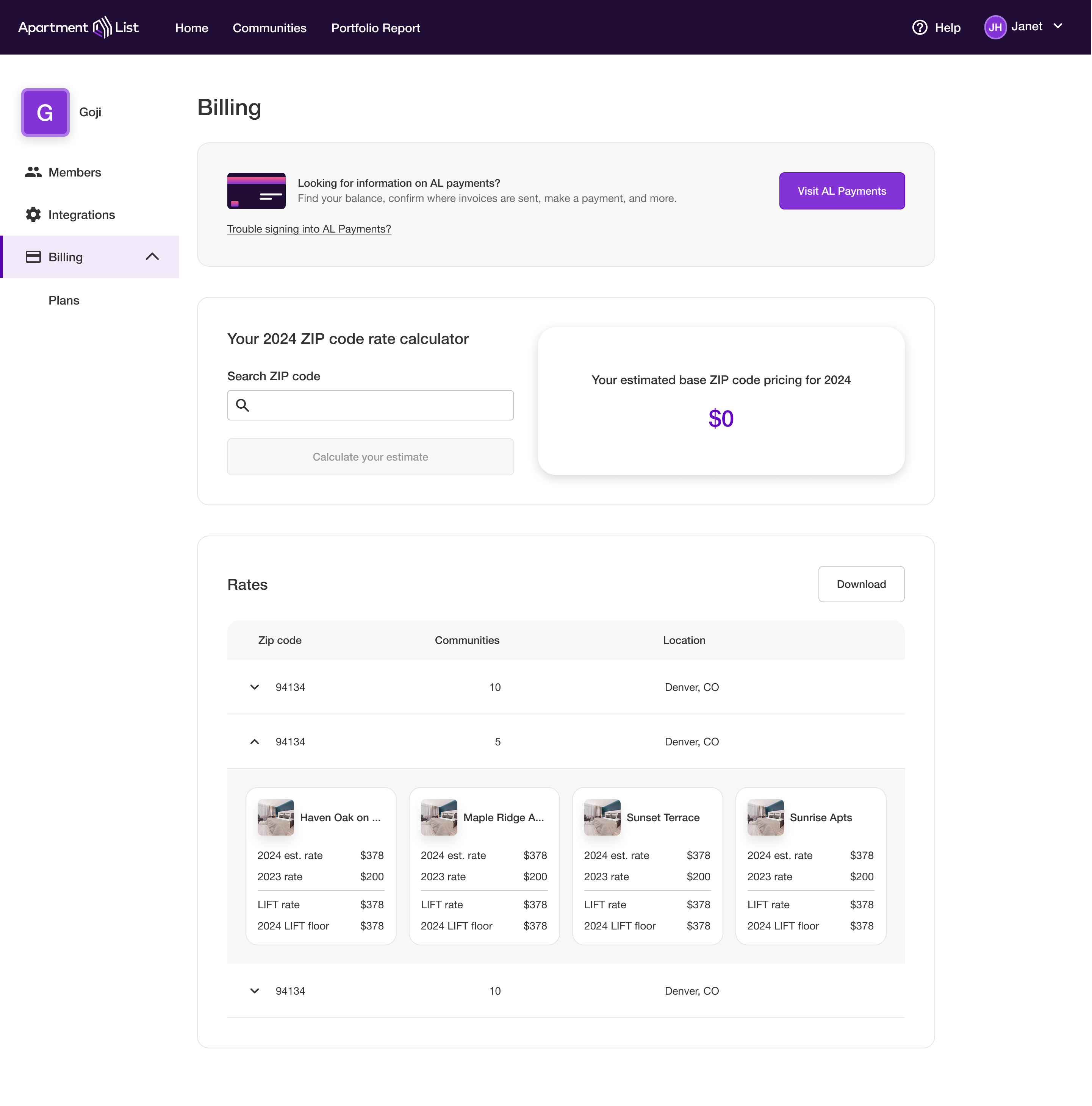
Early exploration into what information increased split second decisions.
» Pros
Transparency rebuilds trust and supports self-service upgrades.
Ø Cons
None.
» Pros
Aggregating prices to a single price may reduce confusion.
Ø Cons
Property managers needed an itemized breakdown.
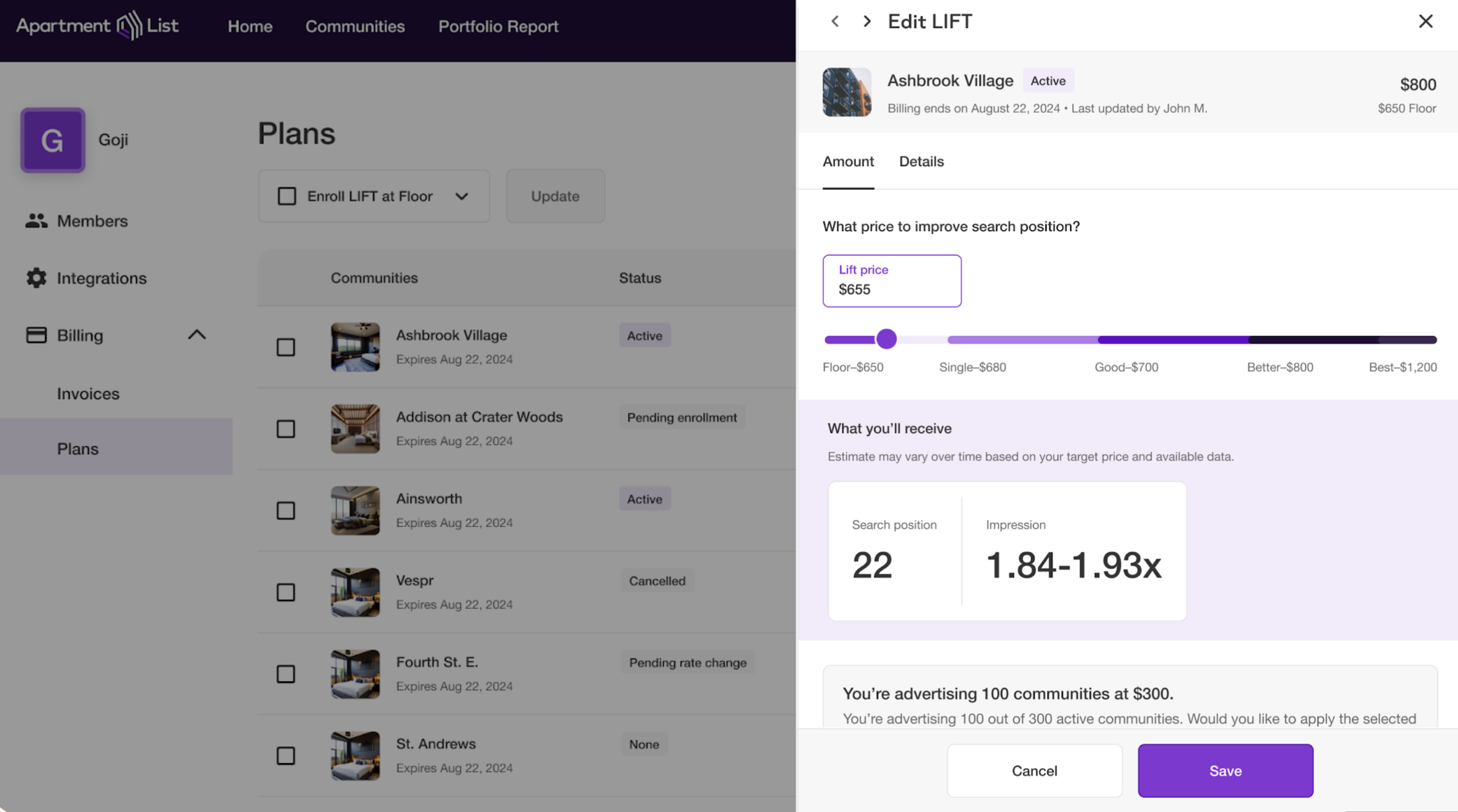
Implement self-service upsell and bidding paths that allow partners to upgrade or bid for premium placement directly in context.
Options: Sales-mediated upsell / redirect to separate portal / in-context self-service
Constraint: Cognitive load + reduce Sales dependency
Call: Self-service upsell flows embedded directly in workflow
Risk: Potential misclicks / revenue errors
Mitigation: Confirmations, clear pricing transparency, progressive onboarding
Proof: Measurable adoption of premium features; finance could forecast revenue accurately
Embed upsell banners within the ecosystem to convert in the funnel.
Standalone to bulk convert at the moment they need it.
» Pros
Fast to build
Consistent
Ø Cons
Existing pattern showed unexpected behavior.
» Pros
Fast to build
Default selection reduces cognitive load
Ø Cons
Existing pattern is harder to scan and compare options.

"No more hunting for what I just paid for."
Partners can now see and understand their rates, reducing churn and confusion, while support escalations dropped ~40%. Subscription add-ons and premium feature adoption increased, Finance can forecast revenue accurately without manual reconciliation, and Sales can confidently upsell through self-service flows. The system delivers immediate monetization while laying the foundation for long-term platform strategy.
"Before this, I’d spend hours tracking invoices and understanding attribution. Now it’s all there."
"I can actually see how every charge adds up, and I don’t have to bug anyone to make changes anymore."
"I ended up upgrading a few units myself because it was so easy to understand the options and what they cost."
20% ↑
ARR
40% ↓
Drop in tickets
8% ↑
Upsell
Running small experiments drives confidence
This project illustrates how I lead teams: one step at a time. Tackling big, complex challenges isn’t about leaping to the summit; it’s about setting a clear path, taking measured steps, and adjusting as you go. Instead of waiting for a single breakthrough, I ran small, incremental experiments, each providing insight and building momentum toward our ultimate goal.
When full-scale solutions aren’t feasible, identify the small steps.
Aligning early ensures design decisions shape company strategy.
Provides foundation for future configurable pricing & invoices.