Brivon~6 min read
What we automated stopped where a patient’s appeal began.
By week two, the AI could draft an appeal letter. I chose not to ship it.
- Role: Product strategy and design
- Timeline: Side project
- Team: Me, with an AI product manager
- Impact: Not measured yet
- Platform: Web
The short version
A prior authorization denial, where an insurer refuses to pre-approve treatment, arrives as a PDF. It is three pages written for auditors, with one sentence in the middle telling a patient their surgery was denied. The 60-day appeal window starts that day. An appeal succeeds roughly half the time when someone who knows the system files it. Most patients never find the sentence.
Brivon was an attempt to offer that help to thousands of patients without burning out the advocates who handle one case at a time. Medicare began reimbursing advocacy services in 2024, taking one competitor from a Series A to a billion-dollar valuation in eighteen months.
Trust was the hard part, from patients and advocates at once. Every decision below is a decision to hold automation back.
What I owned
I owned
- The whole product: strategy, market entry, brand, structure, and every screen
- The market audit, and the call to enter on insurance denials rather than advocacy generally
- Phase sequencing, and what automation was allowed to touch in each
- The trust model: outcomes as patterns, a published acceptance rate, structured ratings
- Two critique passes, and triaging which findings were real debt
Shared with an AI product manager
- Requirements and scope, in a loop I spent the first month generating the friction inside
- The build itself, whose first answers I killed
Problem
Insurers got AI first. Patients did not.
Prior authorizations get denied on technicalities. Bills arrive with errors no layperson can catch. Someone with a serious diagnosis manages their condition and fights a bureaucratic process at the same time, against institutions with better lawyers and more time.
Insurers now run AI on claims and deny them faster than any human could, and denial rates are at record highs. Patients have nothing comparable.
Start where a win is measurable
Where could we prove we were helping?
I chose prior authorization appeals rather than care navigation for newly diagnosed patients, billing disputes, or a general health platform. Care navigation had the highest emotional intensity, but its win condition was too diffuse to assess in weeks; a prior authorization case is approved or it isn’t. The narrow entry point would make a small business if adjacent workflows never opened up, but its binary outcome also made a success fee possible without a track record and let us tell whether the product worked before there was enough data to model anything.
AI can triage. Humans write.
The AI could draft. Why not let it?
I limited Phase 0 to AI-assisted intake and classification, manual advocate work, and a case timeline, rather than a full case copilot that drafted appeals, summarized history, extracted facts, and suggested actions, or drafting with advocate review. All of it was reachable by week two, but every week AI stayed out of drafting left advocates writing appeals by hand on a success fee that only pays when cases close. I accepted that cost because a slow advocate loses margin, while an advocate who stops trusting the classifier checks every call by hand and costs more than the automation saved. An advocate who catches the AI wrong twice stops trusting the system; one who saves two hours while staying in control tells other advocates. The model and accuracy are the same, but what it touches first changes the outcome.
I hated this decision. It was still right.
The stakes set the gate: a misclassified denial type routes to the wrong appeal template, and a missed deadline postpones somebody’s surgery. Nothing leaves the building without an advocate reading it first. That gate is the product.
See the urgent work first
What does an advocate need to see first?
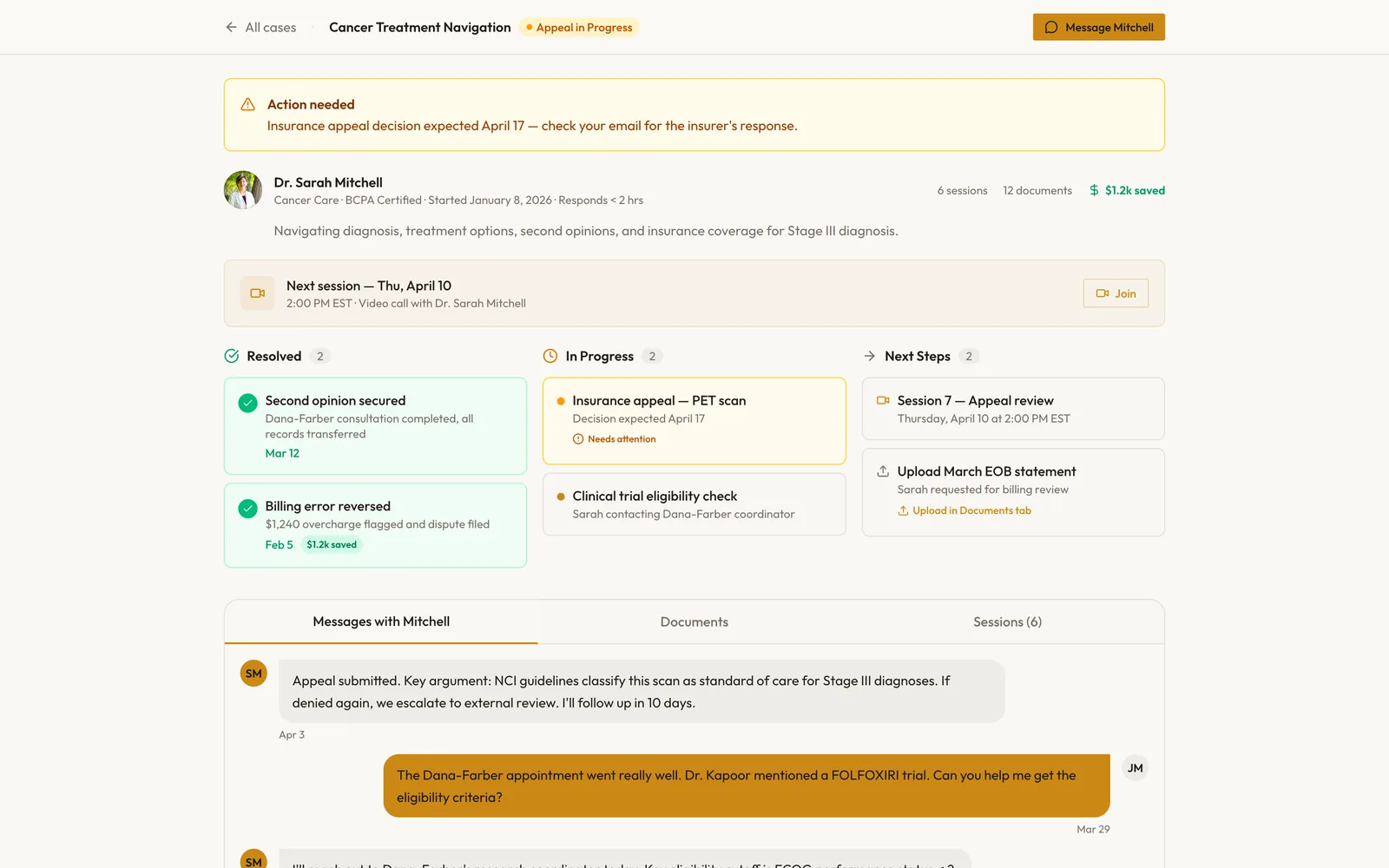
I chose a ranked queue with the required action on each card over one case per screen with full depth or a status list. The depth-first version required backing out, scanning, and clicking into the next urgent case, creating eight context switches across eight active cases before the day began; the queue puts a prior authorization deadline expiring today above a document review that can wait until Thursday, while care plans, activities, and documentation stay inside the case. Too little on a card would make advocates open everything and too much would make eight stacked cards unreadable, so each has patient name, case type, next required action, and deadline. Testing showed advocates also wanted their workload on screen, not only patient status: a session summary changed “I can see what my patients need” to “I can see what my day looks like,” a difference tied to burnout.
Proof without exposing patients
How do you show a track record without exposing patients?
I led profiles with aggregate outcome patterns against named insurers rather than credentials or named patient testimonials. The first profile ordered credentials, specialties, and experience like a resume, but patients managing chronic pain wanted someone who had beaten their insurer on their condition, and patient narratives would expose people. Profiles use patterns such as “15 of 17 denials at this insurer for this condition reversed on first appeal,” with ratings separated into communication, resolution, and speed. Publishing an acceptance rate gives patients a selection signal but creates liability if criteria aren’t legible, so the criteria sit alongside it. In testing, patients identified the rate as what separated the product from a directory: “So they’re not just listing everyone.”
What shipped
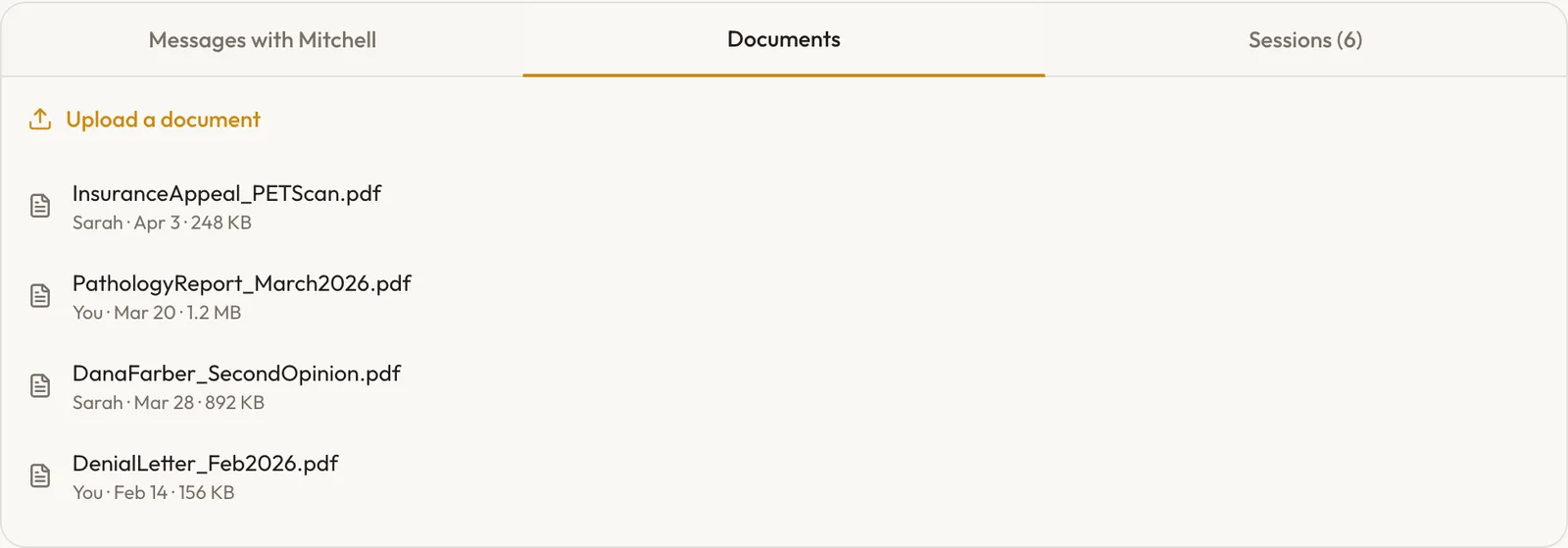
We shipped structured and conversational intake, case-type classification and urgency routing, a case timeline with status and next action, outcome tracking across won, partial, and loss, and document ingestion for bills, explanations of benefits, and denial letters.
I cut AI-drafted appeals, proactive deadline monitoring, employer dashboards, and any browsing surface.
The brand took three directions. Clinical Authority read like a hospital’s internal tool, putting us on the institution’s side of the table. Warm Advocacy was called a meditation app. Earned Confidence came from asking what someone looks like when they have done this before and won.
What I would measure
There are no results yet. Phase 0 passes if 70% or more of cases reach a clear outcome signal inside the case lifecycle. I would also watch advocate throughput on a half-automated system, because that tells me whether Phase 1 automation has earned deployment.
None of that has happened. These are pilot hypotheses, not results.
The dangerous parts are still unresolved
The unresolved parts aren’t cosmetic. I shipped a flat, reverse-chronological documents panel even though a denial letter at intake and that letter filed as appeal evidence are different objects sharing a file type. “How I work” is also still one block an advocate writes once, although prior authorization appeals and billing disputes need different versions; the structure already holds the fix.
The harder complication was the working relationship. An AI product manager could generate a plausible-looking advocacy workflow in an afternoon, and for the first month I was the only one asking what happens when it is wrong. That question became shared eventually, but the project ended before I could see whether the friction became culture or remained a weekly cost. Speed was never the problem. In a product like this, somebody has to keep asking what happens when it is wrong, and keep asking until the rest of the team picks it up.